The conversation around the “future of work” has changed.
For years, it was mainly about where and when we work: remote work, hybrid teams, flexible hours and digital collaboration.
Today, AI has pushed a different question to the front: what will people actually spend their time doing when technology can do more of the work itself?
At OpsOlive, we think that is one of the most interesting questions businesses should be asking right now. The future of work isn’t simply about adding AI tools to the way we already operate. It is an opportunity to rethink how work gets done in the first place.
So, what is the “future of work”?
There isn’t one universally agreed definition.
Broadly, the term describes how work, workplaces and workforces are evolving in response to technology, demographic change, new business models and changing employee expectations. Right now, AI and automation are accelerating that change.
The World Economic Forum estimates that structural changes in the labour market could affect 22% of today’s formal jobs by 2030. Its Future of Jobs Report 2025 estimates that 170 million jobs could be created while 92 million are displaced, a net increase of 78 million jobs globally. This isn’t simply a story about jobs disappearing. It is also about jobs, and the tasks within them, changing.
More recent McKinsey research makes a similar distinction. It estimates that technologies available today could theoretically automate activities accounting for roughly 57% of current US work hours. It explicitly cautions that this is not a forecast that 57% of jobs will disappear. Roles are likely to change as some activities are handled by technology and humans focus on others.
So the question shouldn’t be “Which jobs can we automate?” A much more useful question is: which parts of work should technology do, and where do humans add the most value?
From replacing people to augmenting them
The popular narrative around AI often positions humans and technology as competitors. The emerging reality is more nuanced.
McKinsey describes the future workforce as a partnership between people, AI agents and robots, with people increasingly directing, interpreting and collaborating with technology rather than performing every task themselves. Its research also finds that more than 70% of the skills employers currently seek are used across both automatable and non-automatable work. Many human skills aren’t disappearing. We are changing where we use them.
Think about an operations professional. How much of their week is spent copying information between systems, maintaining spreadsheets, chasing approvals, compiling reports, sending routine follow-ups or performing repetitive administrative checks?
Now imagine that much of that work happens automatically. What could that person do with the time they get back?
Talk to customers. Solve problems. Improve processes. Build relationships. Spot opportunities. Make decisions. Think creatively about what’s next.
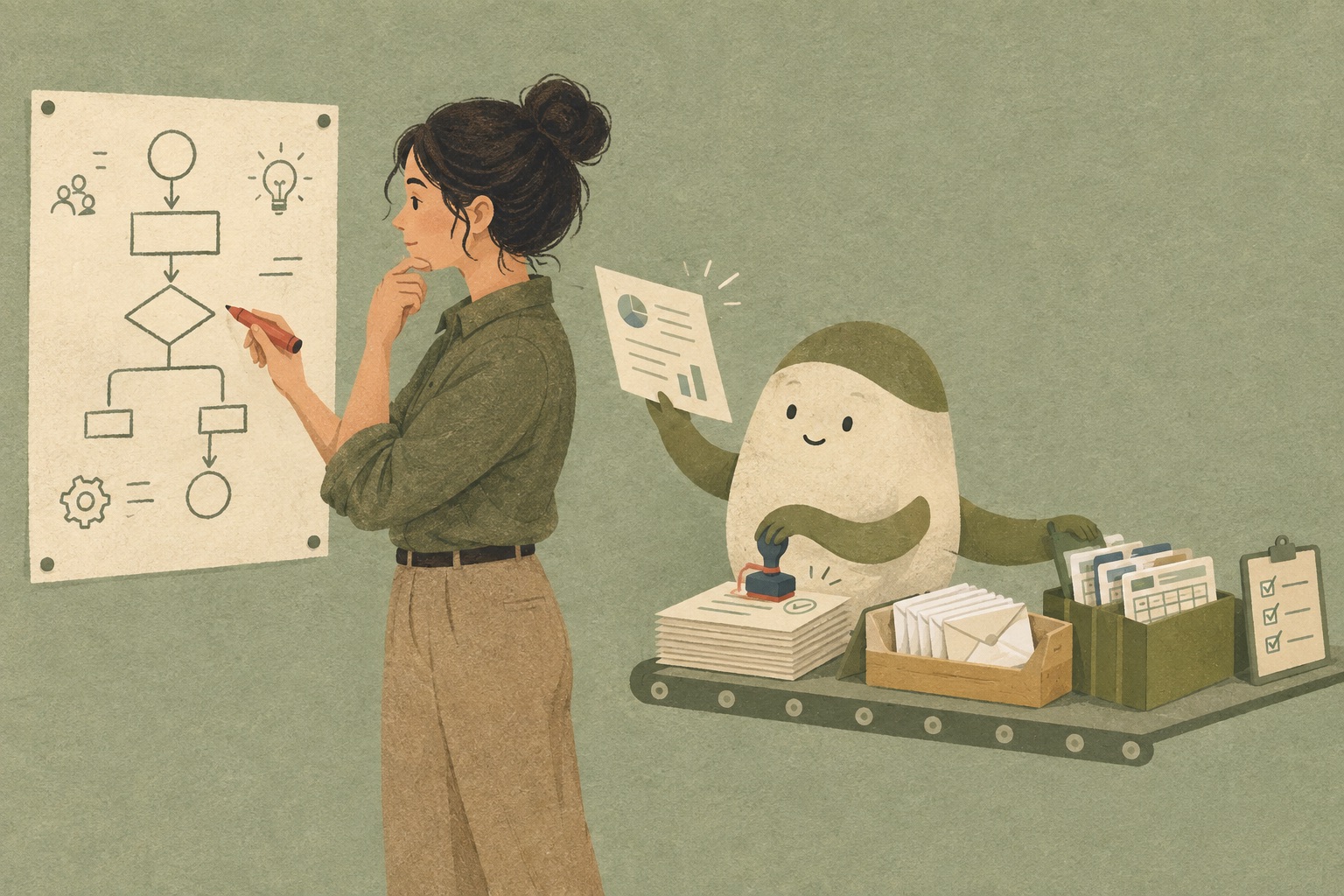
That is the future of work we are interested in. Not removing humans from operations, but removing the work that prevents humans from adding value.
But you can’t automate what you don’t understand
The explosion of AI tools has made it surprisingly easy to automate something. That doesn’t mean businesses are automating the right things.
Most workflow and automation tools start with the same question: “What do you want to automate?” Many operations teams don’t know. They know people are spending too much time on manual work. They know information lives in too many places. They know certain processes are frustrating and that something could work better.
What they don’t always have is a holistic picture of how the business actually operates. Operational knowledge is scattered across employee handbooks, SOPs, process documentation, spreadsheets, internal guides, different software platforms and people’s heads. Before we automate work, we need to understand it.
Map first. Automate second.
That is the thinking behind OpsOlive. Instead of asking a business what it wants to automate, we start by mapping how the business actually works.
OpsOlive uses the operational documentation a company already has, such as SOPs, employee handbooks, internal guides and process documentation, to build a holistic picture of its workflows. From there, we can start identifying:
- manual and repetitive work
- unnecessary handoffs
- bottlenecks
- duplicated processes
- disconnected information
- opportunities for automation and optimisation
Only then do we ask what technology should take care of. And, equally important, what should remain human.
Automation shouldn’t be the objective. Better work should be the objective.
The future of work needs workflow redesign, not just more AI tools
McKinsey’s 2025 research argues that larger gains from AI are likely to come from redesigning entire workflows, rather than automating individual tasks within existing ones. That is a fundamental shift.
Adding AI to a broken process doesn’t fix the process. Sometimes you just end up doing the wrong thing faster.
The opportunity is to look at the operation as a whole. Why does this process exist? Where does the information come from? Who needs to be involved? Where does work get stuck? Which decisions genuinely require human judgment? Which actions could happen automatically?
Only when we understand those relationships can we design workflows where humans and technology complement one another.
More time for what matters
We don’t believe the future of work is a company where humans have been automated out of the picture. We believe it is one where people spend far less of their working lives doing things technology can do perfectly well for them. AI handles the repetitive execution. Automation keeps information moving. Systems take care of routine follow-ups.
And humans get more capacity for the things they are particularly valuable at: judgment, creativity, relationships, leadership, empathy and solving problems that don’t come with a predefined workflow.
Technology has always changed work. AI will too. The companies that benefit most may not be the ones that simply adopt the most AI. They may be the ones that first understand how their business actually works, then deliberately redesign that work around what humans and technology each do best.
That is our vision of the future of work. Map first. Automate second. Move forward.
Describe how your business process works. We turn it into your system.